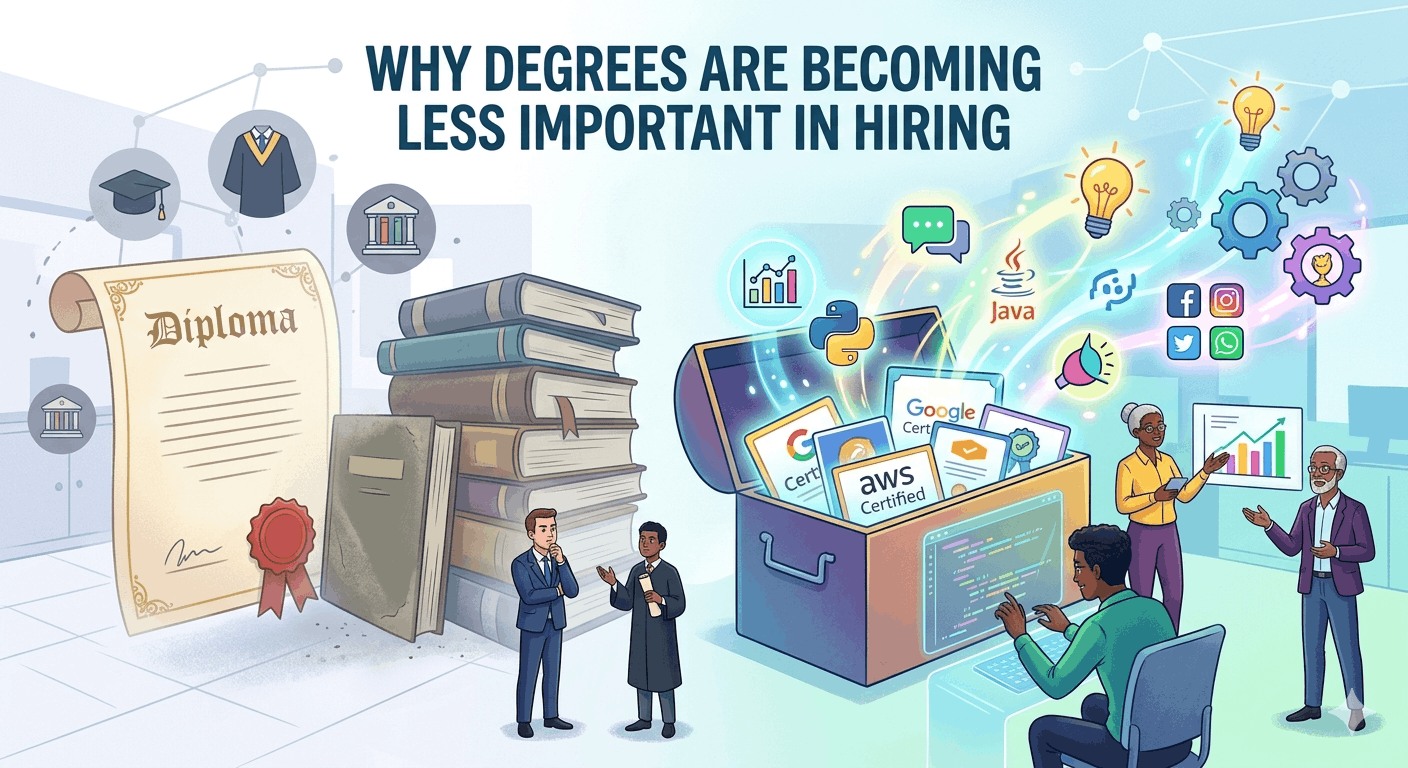
Introduction: A Shift in Hiring Mindset
The traditional hiring model has long prioritized academic degrees as the primary measure of a candidate's potential. However, in today's evolving job market, this approach is rapidly changing. Organizations are increasingly focusing on skills, experience, and adaptability rather than formal qualifications.
This transformation is especially evident in modern HRMS-driven workplaces, where data and performance metrics provide deeper insights into employee capabilities. As a result, degrees are no longer the sole indicator of success.
Why Degrees Are Losing Their Dominance
Several factors are contributing to the declining importance of degrees in hiring decisions.
Changing Industry Requirements
Industries are evolving faster than academic curriculums. Many degrees fail to keep up with real-world demands, making practical skills more valuable.
Rise of Skill-Based Learning
Online platforms and certifications allow individuals to gain job-ready skills without pursuing traditional degrees.
Technology-Driven Hiring
Modern HRMS systems enable recruiters to assess candidates based on performance, portfolios, and competencies rather than just educational background.
Demand for Practical Experience
Employers prioritize candidates who can demonstrate their abilities through real-world projects and experience.
The Role of HRMS in Skill-Based Hiring
Human Resource Management Systems are playing a crucial role in reshaping hiring practices by focusing on measurable performance indicators.
Data-Driven Recruitment
HRMS platforms analyze candidate data, helping organizations make informed hiring decisions based on skills and achievements.
Competency Mapping
Organizations can match job requirements with candidate skills more accurately, reducing reliance on degrees.
Performance Tracking
HRMS tools allow companies to evaluate employee performance over time, reinforcing the importance of skills over qualifications.
- Better alignment between job roles and candidate skills
- Reduced hiring bias based on educational background
- Improved workforce productivity
- Enhanced employee development strategies
- Greater focus on continuous learning
Benefits of Skills-Based Hiring
Shifting focus from degrees to skills offers multiple advantages for organizations and employees alike.
Wider Talent Pool
Companies can access a broader range of candidates, including those without traditional degrees but with strong capabilities.
Improved Job Performance
Employees hired for their skills are more likely to perform effectively in their roles.
Increased Diversity
Removing degree requirements promotes inclusivity and diversity within the workforce.
Faster Hiring Process
Evaluating candidates based on practical abilities speeds up recruitment decisions.
In the modern workplace, what you can do matters more than what degree you hold.
Degrees vs Skills: A New Perspective
The debate between degrees and skills highlights the changing priorities of employers.
Key Differences
- Degrees represent education; skills demonstrate ability
- Degrees are static; skills evolve continuously
- Degrees focus on theory; skills emphasize practice
- Degrees take years; skills can be acquired faster
- Degrees may not reflect performance; skills directly impact results
Challenges of Moving Away from Degree-Based Hiring
Despite its advantages, transitioning to a skills-based approach comes with certain challenges.
Standardizing Skill Assessment
Measuring skills objectively can be complex without proper tools and frameworks.
Bias Toward Traditional Credentials
Some organizations still rely on degrees as a benchmark, slowing adoption of new hiring models.
Training and Development Needs
Employers may need to invest more in training employees to bridge skill gaps.
Verification of Skills
Ensuring the authenticity of claimed skills requires robust evaluation methods.
How Organizations Can Adapt
To embrace this shift effectively, companies must rethink their recruitment strategies.
1. Redefine Job Requirements
Focus on essential skills and competencies instead of mandatory degrees.
2. Use HRMS Tools Effectively
Leverage HR technology to track, assess, and manage employee performance.
3. Implement Skill Assessments
Introduce practical tests and real-world scenarios during hiring.
4. Promote Continuous Learning
Encourage employees to upgrade their skills through training programs.
5. Build a Skill-Centric Culture
Create an environment where learning and growth are prioritized over credentials.
The Future of Hiring
The future of recruitment lies in recognizing talent beyond traditional metrics. As organizations continue to adopt digital tools and data-driven approaches, the emphasis on skills will only grow stronger.
Integration of AI in Hiring
Artificial intelligence will further enhance the ability to evaluate candidates based on skills and performance.
Global Talent Accessibility
Remote work trends will enable companies to hire skilled professionals from anywhere in the world.
Continuous Workforce Development
Learning will become an ongoing process, supported by HRMS platforms and training initiatives.
Conclusion: Skills Are the New Currency
The decline of degree-centric hiring marks a significant shift in how organizations identify and nurture talent. By focusing on skills, adaptability, and real-world performance, companies can build stronger, more capable teams.
In this new era, success is defined not by the certificates on a wall, but by the value individuals bring to the workplace.