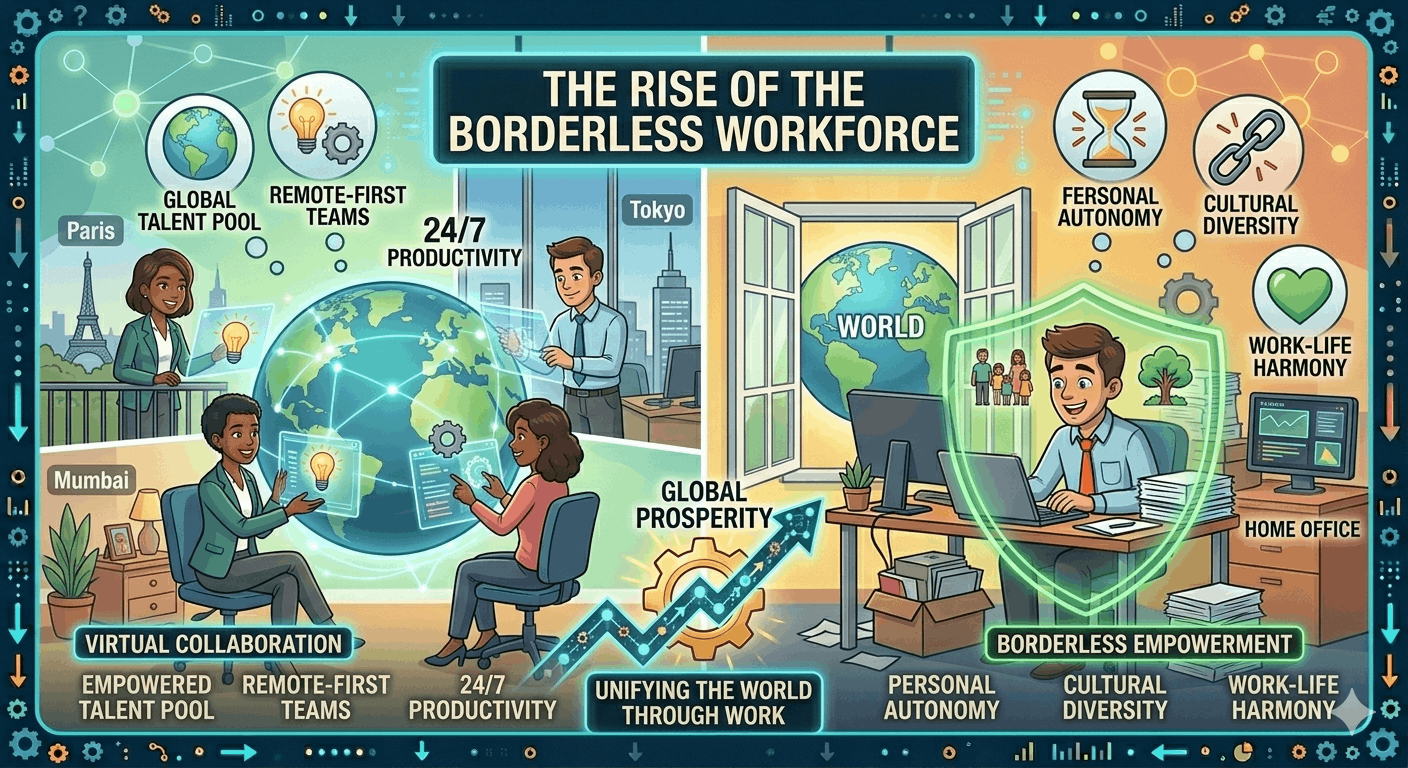
Introduction: Work Without Borders
The concept of work has undergone a remarkable transformation in recent years. With the advancement of technology and the normalization of remote work, the idea of a borderless workforce is no longer futuristic—it is today's reality.
Organizations are no longer limited by geography when hiring talent. Instead, they are building diverse, global teams that collaborate across time zones and cultures. This shift is redefining how businesses operate and compete in a global economy.
What Is a Borderless Workforce?
A borderless workforce refers to a work environment where employees can operate from anywhere in the world without being restricted by physical office locations or national boundaries.
Key Characteristics of a Borderless Workforce
- Global talent acquisition without geographical limitations
- Remote-first or fully distributed teams
- Dependence on digital collaboration tools
- Flexible work arrangements across time zones
- Diverse and multicultural teams
Why the Borderless Workforce Is Growing
The rise of this model is driven by multiple factors that align with modern business needs and employee expectations.
1. Technological Advancements
Cloud computing, communication tools, and collaboration platforms have made it easier than ever to work from anywhere.
2. Demand for Flexibility
Employees increasingly value flexibility in where and how they work, making remote opportunities more attractive.
3. Access to Global Talent
Companies can hire the best talent regardless of location, giving them a competitive advantage.
4. Cost Optimization
Reducing reliance on physical offices lowers operational costs while maintaining productivity.
Benefits of a Borderless Workforce
Adopting a borderless workforce model offers numerous advantages for both organizations and employees.
Enhanced Innovation
Diverse perspectives from different cultures and backgrounds lead to more creative solutions and ideas.
Improved Productivity
Employees working in environments they choose often perform better and are more focused.
Greater Employee Satisfaction
Flexibility and autonomy contribute to higher job satisfaction and retention rates.
Business Scalability
Organizations can expand into new markets without the need for physical presence.
The future of work is not defined by location, but by connection, collaboration, and capability.
Challenges of Managing a Borderless Workforce
While the benefits are significant, managing a global workforce also presents unique challenges.
Communication Barriers
Time zone differences and language barriers can complicate communication and collaboration.
Cultural Differences
Understanding and respecting diverse cultural norms is essential for maintaining harmony within teams.
Compliance and Legal Issues
Different countries have varying labor laws and regulations that organizations must navigate carefully.
Team Cohesion
Building strong relationships and maintaining team spirit can be challenging without physical interaction.
Borderless Workforce vs Traditional Workforce
The contrast between traditional and borderless work models highlights the evolution of modern workplaces.
Key Differences
- Traditional workforce is location-bound; borderless workforce is global
- Traditional workforce relies on offices; borderless workforce operates remotely
- Traditional workforce limits hiring; borderless workforce expands opportunities
- Traditional workforce follows fixed schedules; borderless workforce enables flexibility
- Traditional workforce is homogeneous; borderless workforce is diverse
Best Practices for Leading a Borderless Workforce
To successfully manage global teams, leaders must adopt new strategies and approaches.
1. Prioritize Clear Communication
Use structured communication channels and ensure clarity in messaging across teams.
2. Embrace Cultural Diversity
Encourage inclusivity and celebrate cultural differences to build a stronger team environment.
3. Leverage Technology
Invest in reliable tools that enable seamless collaboration and productivity.
4. Set Clear Expectations
Define roles, responsibilities, and performance metrics to avoid confusion.
5. Foster Team Connection
Organize virtual events and regular check-ins to strengthen relationships.
The Future of the Borderless Workforce
The borderless workforce is expected to grow as organizations continue to embrace digital transformation and flexible work models.
Increased Global Collaboration
Teams will become more interconnected, working seamlessly across continents.
Advanced Digital Ecosystems
Emerging technologies will further enhance remote work capabilities and collaboration.
Focus on Outcomes
Performance will increasingly be measured by results rather than physical presence.
Conclusion: Embracing a Borderless Future
The rise of the borderless workforce marks a significant shift in how businesses operate and grow. It offers unparalleled opportunities for innovation, diversity, and scalability.
By embracing borderless work models, organizations can unlock global potential and build a future-ready workforce that thrives beyond boundaries.