Introduction: The Overlooked Employee Journey
Most companies invest heavily in recruitment but often fail to pay attention to what happens after hiring. The employee journey—from onboarding to exit—is frequently ignored, leading to disengagement and high turnover.
In reality, every interaction an employee has with an organization shapes their experience. When companies overlook these moments, they miss opportunities to build loyalty and productivity. The true success of HR lies not just in hiring talent, but in nurturing it.
What Is the Employee Journey?
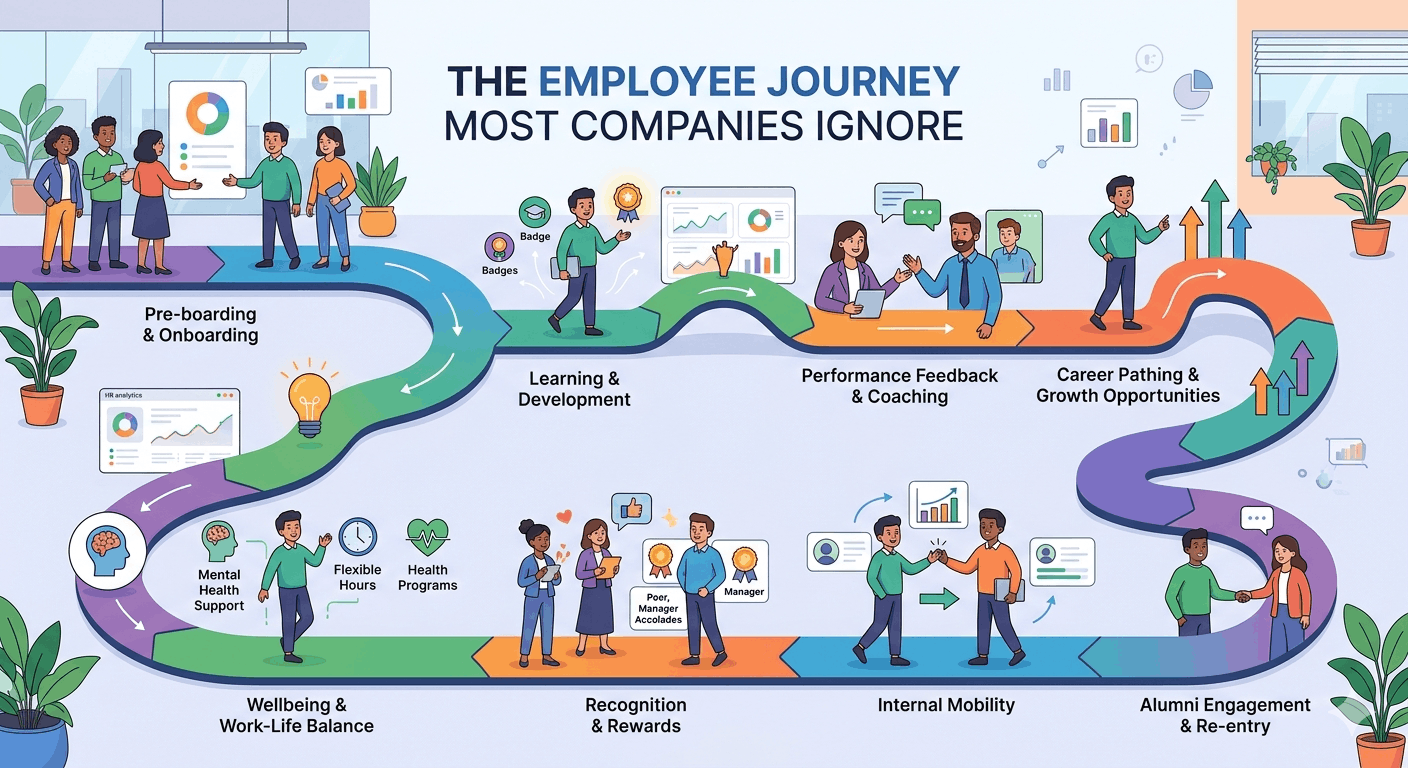
The employee journey refers to the complete lifecycle of an employee within an organization. It includes every stage from initial contact to post-exit engagement.
Key Stages of the Employee Journey
- Attraction and recruitment
- Onboarding and training
- Performance and development
- Engagement and retention
- Exit and alumni connection
Why Companies Ignore the Employee Journey
Despite its importance, many organizations fail to prioritize the full employee lifecycle.
Focus on Hiring Metrics
Companies often measure success based on recruitment numbers rather than long-term employee outcomes.
Lack of HR Technology
Without advanced HRMS systems, tracking and managing the employee journey becomes difficult.
Short-Term Business Goals
Organizations focused on immediate results may overlook long-term employee development.
Limited Leadership Awareness
Leaders may underestimate the impact of employee experience on business success.
The Hidden Costs of Ignoring the Employee Journey
Neglecting the employee journey can have significant consequences for organizations.
High Turnover Rates
Employees who feel unsupported are more likely to leave, increasing recruitment costs.
Low Engagement Levels
Lack of attention to employee experience leads to disengagement and reduced productivity.
Poor Employer Branding
Negative employee experiences can damage a company's reputation in the job market.
Decreased Productivity
Unmotivated employees contribute less effectively to organizational goals.
An employee's journey defines their performance, loyalty, and impact on the organization.
The Role of HRMS in Managing the Employee Journey
Modern HRMS platforms enable organizations to track and enhance every stage of the employee lifecycle.
Centralized Data Management
HRMS systems store employee data in one place, providing a complete view of their journey.
Automated Processes
Automation ensures consistency and efficiency in onboarding, performance reviews, and engagement activities.
Real-Time Insights
Data analytics help organizations identify gaps and improve employee experiences.
- Improved employee satisfaction
- Better retention strategies
- Enhanced performance tracking
- Streamlined HR operations
- Stronger organizational culture
Key Moments That Matter in the Employee Journey
Understanding critical touchpoints helps organizations create meaningful employee experiences.
Onboarding Experience
A strong onboarding process sets the tone for an employee's entire journey.
Career Development Opportunities
Employees value growth and learning opportunities within the organization.
Performance Feedback
Regular feedback helps employees improve and stay aligned with goals.
Recognition and Appreciation
Acknowledging contributions boosts morale and engagement.
How to Improve the Employee Journey
Organizations must take proactive steps to enhance every stage of the employee lifecycle.
1. Map the Employee Journey
Identify key touchpoints and evaluate employee experiences at each stage.
2. Invest in HR Technology
Use HRMS tools to streamline processes and gain valuable insights.
3. Focus on Employee Experience
Create a positive and supportive work environment.
4. Encourage Open Communication
Provide platforms for employees to share feedback and concerns.
5. Promote Continuous Learning
Offer training and development programs to support growth.
Employee Journey vs Traditional HR Approach
The shift from traditional HR practices to a journey-focused approach highlights the evolution of workforce management.
Key Differences
- Traditional HR focuses on processes; employee journey focuses on experiences
- Traditional HR is reactive; employee journey is proactive
- Traditional HR measures tasks; employee journey measures satisfaction
- Traditional HR is department-centric; employee journey is employee-centric
- Traditional HR handles events; employee journey manages relationships
The Future of Employee Experience
As workplaces evolve, the focus on employee journey will continue to grow.
Personalized Experiences
Organizations will tailor experiences to individual employee needs.
Integration of AI and Analytics
Advanced technologies will provide deeper insights into employee behavior and preferences.
Holistic Employee Well-Being
Companies will prioritize mental, emotional, and physical well-being.
Conclusion: A Journey Worth Investing In
The employee journey is not just an HR concept—it is a strategic advantage. Organizations that invest in understanding and improving this journey can achieve higher engagement, better retention, and stronger performance.
By focusing on every stage of the employee lifecycle, companies can build a workplace where employees thrive and contribute their best.