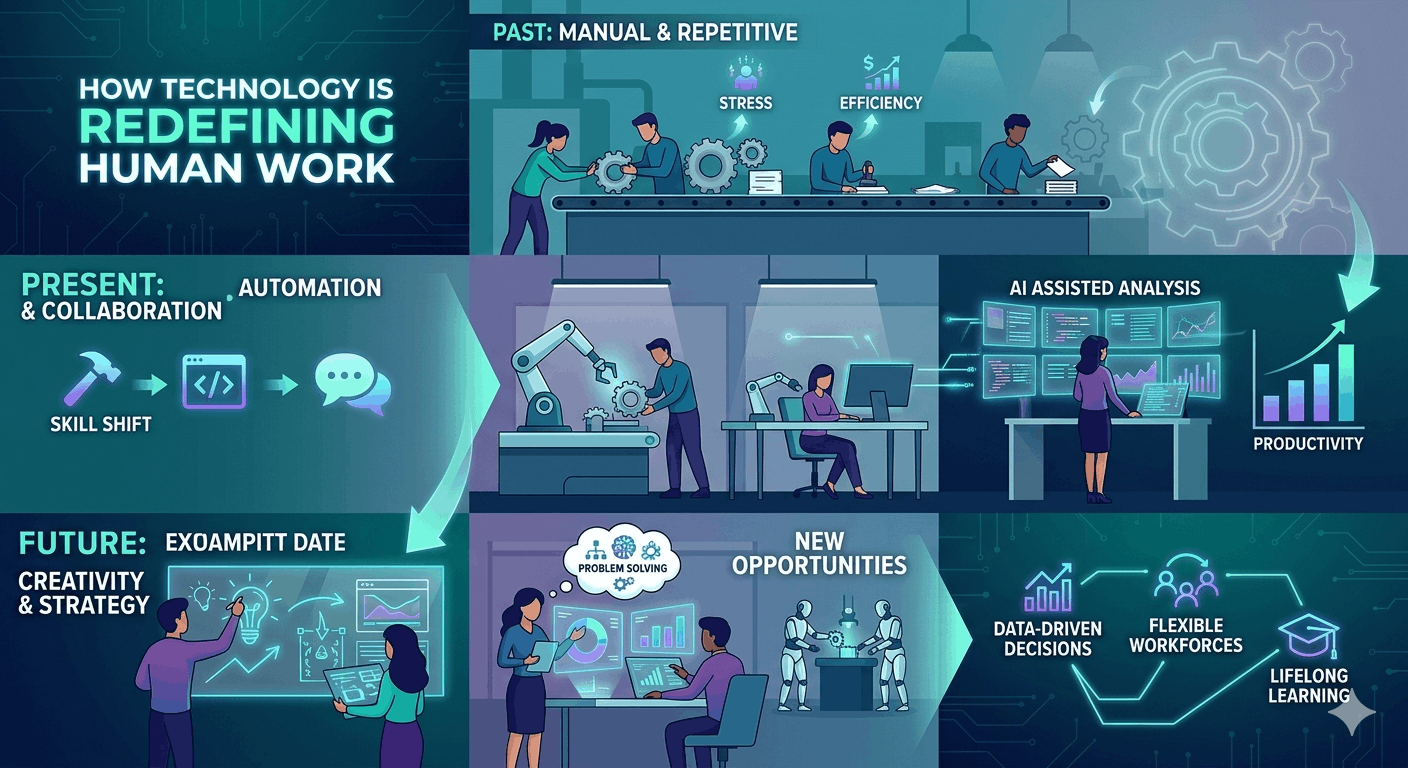
Introduction: A New Era of Work
The nature of human work is evolving at an unprecedented pace. With rapid advancements in technology, traditional job roles are being redefined, and new opportunities are emerging across industries.
From automation to artificial intelligence, technology is not just changing how work is done—it is transforming what work means. Organizations and individuals must adapt to this shift to remain relevant in an increasingly digital world.
The Evolution of Work Through Technology
Work has always evolved alongside technological progress. Today, digital transformation is accelerating this change faster than ever before.
From Manual to Digital
Tasks that once required manual effort are now automated through software and machines, improving efficiency and accuracy.
The Rise of Smart Systems
Artificial intelligence and machine learning systems are enabling smarter decision-making and predictive capabilities.
Connected Work Environments
Cloud computing and collaboration tools have made it possible for teams to work seamlessly across locations.
Key Technologies Shaping Human Work
Several technologies are playing a significant role in redefining how work is performed and managed.
1. Artificial Intelligence
AI systems analyze data, automate processes, and enhance decision-making across industries.
2. Automation
Routine and repetitive tasks are increasingly handled by automated systems, allowing humans to focus on complex work.
3. Cloud Computing
Cloud platforms enable remote access to data and applications, supporting flexible work models.
4. Collaboration Tools
Digital tools facilitate communication and teamwork, regardless of geographical location.
5. Data Analytics
Organizations use data insights to drive strategies, improve performance, and make informed decisions.
- Faster task execution through automation
- Improved accuracy and reduced human error
- Enhanced collaboration across teams
- Greater access to global opportunities
- Continuous innovation and improvement
The Impact on Jobs and Skills
Technology is reshaping job roles and the skills required to succeed in the modern workforce.
Shift in Skill Demand
There is a growing demand for digital skills, critical thinking, and adaptability in today's workplace.
Creation of New Roles
Emerging technologies are creating entirely new job categories that did not exist a decade ago.
Reskilling and Upskilling
Continuous learning has become essential for professionals to stay competitive.
Technology does not replace humans; it empowers them to achieve more.
Technology vs Human Capabilities
While technology enhances efficiency, human qualities remain irreplaceable in many areas.
Key Differences
- Technology processes data; humans interpret meaning
- Technology follows logic; humans use creativity
- Technology is consistent; humans are adaptable
- Technology executes tasks; humans build relationships
- Technology analyzes patterns; humans understand emotions
Challenges of Technological Transformation
Despite its benefits, the integration of technology into work comes with challenges.
Job Displacement Concerns
Automation may replace certain roles, creating uncertainty for workers.
Digital Divide
Not all individuals and organizations have equal access to advanced technologies.
Workplace Adaptation
Adapting to new tools and systems requires time, training, and investment.
Data Privacy and Security
Increased reliance on digital systems raises concerns about data protection.
The Future of Human Work
The future of work will be defined by collaboration between humans and technology.
Human-Tech Collaboration
Technology will handle routine tasks, while humans focus on creativity and strategy.
Flexible Work Models
Digital tools will continue to support remote and hybrid work environments.
Continuous Innovation
Organizations will need to embrace innovation to remain competitive in a rapidly changing landscape.
Conclusion: Embracing the Digital Transformation
Technology is redefining human work in profound ways, creating both opportunities and challenges. The key to success lies in embracing change and adapting to new realities.
By leveraging technology effectively while preserving human creativity and empathy, individuals and organizations can thrive in the future of work.