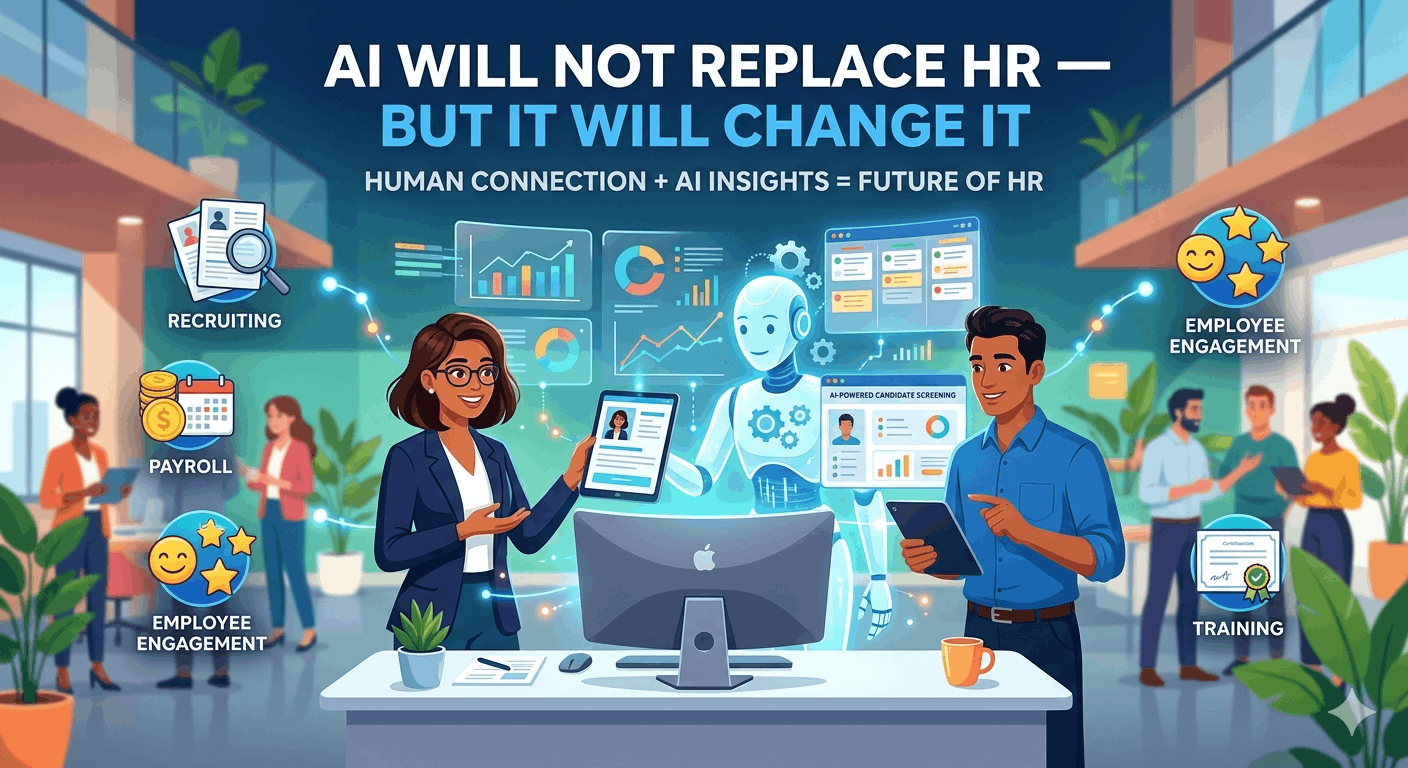
AI Will Not Replace HR — But It Will Change It
The rise of Artificial Intelligence (AI) has sparked widespread debate across industries, and Human Resources is no exception. Many fear that automation will replace HR professionals, but the reality is far more nuanced. AI is not here to eliminate HR—it is here to transform it.
Rather than replacing human judgment, empathy, and strategic thinking, AI enhances HR's ability to operate efficiently and make data-driven decisions. The future of HR lies in collaboration between technology and human insight.
The Evolution of HR in the Age of AI
Human Resources has always evolved alongside business needs. From administrative functions to strategic leadership, HR has continuously adapted. Now, AI is driving the next phase of this evolution.
From Administrative Tasks to Strategic Roles
Traditionally, HR departments spent significant time on repetitive tasks such as payroll, recruitment screening, and compliance tracking. AI is automating these functions, freeing HR professionals to focus on strategic initiatives.
- Automated resume screening
- AI-driven employee analytics
- Chatbots for employee queries
- Streamlined onboarding processes
Data-Driven Decision Making
AI enables HR teams to analyze vast amounts of data quickly. This allows for more informed decisions regarding hiring, performance management, and employee engagement.
How AI Is Transforming HR Functions
AI is already making a significant impact across various HR functions. Its ability to process data and identify patterns is reshaping how organizations manage their workforce.
Recruitment and Talent Acquisition
AI tools can screen resumes, match candidates to job descriptions, and even conduct initial interviews. This speeds up the hiring process while improving accuracy.
- Faster candidate screening
- Reduced hiring bias through data analysis
- Improved candidate matching
- Enhanced recruitment efficiency
- Better talent insights
Employee Engagement and Experience
AI helps HR understand employee sentiment through surveys, feedback tools, and behavior analysis. This enables proactive engagement strategies.
Performance Management
Traditional performance reviews are being replaced by continuous feedback systems powered by AI. These systems provide real-time insights into employee performance.
Key Benefits of AI in HR
- Improved efficiency and productivity
- Enhanced accuracy in decision-making
- Personalized employee experiences
- Reduced administrative workload
The Human Element: Why HR Cannot Be Replaced
Despite its capabilities, AI cannot replicate the human qualities that define effective HR. Empathy, emotional intelligence, and ethical judgment remain uniquely human strengths.
The Importance of Emotional Intelligence
HR professionals handle sensitive issues such as conflict resolution, employee well-being, and organizational culture. These require empathy and understanding that AI cannot fully provide.
Building Relationships and Trust
Trust is the foundation of any successful workplace. Employees need human connection, guidance, and support—elements that technology alone cannot deliver.
AI can process data, but only humans can truly understand people.
Challenges of Integrating AI in HR
While AI offers numerous benefits, its implementation is not without challenges. Organizations must address these issues to maximize its potential.
Ethical Concerns and Bias
AI systems are only as unbiased as the data they are trained on. Ensuring fairness and transparency is critical to avoid unintended discrimination.
Data Privacy and Security
Handling employee data requires strict compliance with privacy regulations. Organizations must ensure that AI systems protect sensitive information.
Resistance to Change
Employees and HR professionals may resist adopting AI due to fear of job loss or lack of understanding. Proper training and communication are essential.
Preparing HR for an AI-Driven Future
To thrive in an AI-enhanced workplace, HR professionals must adapt and develop new skills. The focus should shift from routine tasks to strategic leadership.
Essential Skills for Modern HR Professionals
As AI takes over administrative functions, HR must evolve to remain relevant and impactful.
- Data analysis and interpretation
- Strategic thinking
- Emotional intelligence
- Change management
- Technological literacy
Balancing Technology and Human Touch
The most successful organizations will be those that strike the right balance between AI efficiency and human empathy. HR must act as the bridge between technology and people.
The Future of HR: A Collaborative Approach
The future of HR is not about choosing between humans and machines. It is about leveraging the strengths of both to create a more effective and inclusive workplace.
AI as a Partner, Not a Replacement
AI should be viewed as a tool that enhances HR capabilities rather than replacing them. It allows HR professionals to focus on what truly matters—people.
Driving Organizational Success
By embracing AI, HR can play a more strategic role in driving business success. From talent management to culture building, AI empowers HR to make a greater impact.
The future of HR lies in combining technology with humanity to create workplaces that are both efficient and empathetic.
Conclusion: Transformation, Not Replacement
AI is undeniably changing the landscape of Human Resources. However, it is not replacing HR—it is redefining its role. Organizations that embrace this transformation will unlock new levels of efficiency, insight, and employee satisfaction.
HR professionals who adapt to this shift will become more strategic, influential, and essential than ever before. The key is to embrace AI as a partner and focus on the uniquely human aspects of leadership and people management.